Architectural development and technical product management to advance enterprise decision-making in defense sustainment.

Presenting this work at the International Council on Systems Engineering (INCOSE) 35th International Symposium with my academic advisor, Dr. Thomas Bradley.

Graduation day at Colorado State University after my dissertation defense.
Executive Summary
As part of my doctoral research, I led the end-to-end development of a Decision Analysis Tool designed to evaluate organizational Reliability & Maintainability (R&M) performance across a complex enterprise such as the United States Air Force's KC-46A Tanker fleet. The tool integrates multiple architectural viewpoints, system interactions, and performance criteria into a unified product that allows leaders to compare enterprise behavior to business and operational objectives.
In developing this tool, I operated simultaneously as a product manager, systems engineer, and analyst, translating stakeholder needs and complex enterprise behaviors into a functional, user-operable decision-support product. The result is a rigorously validated analytical tool that enables clearer decision-making, improved organizational insight, and alignment across operational stakeholders.
Challenge
Organizations managing large, distributed maintenance or sustainment enterprises often struggle to evaluate how well their systems, processes, and organizations support fleet-wide R&M performance. Key challenges include:
-
Highly fragmented operational and data environments
-
Lack of standardized metrics to assess enterprise effectiveness
-
Difficulty connecting local actions to global enterprise outcomes
-
Legacy organizational structures that resist transparent performance classification
Before this research, no practical, consolidated product existed that could integrate enterprise architecture insights, operational behaviors, organizational interactions, and performance criteria into a single analytical decision-making tool. The KC-46A fleet served as a case study to apply and evaluate a solution given its enterprise complexity and challenges.
This gap motivated the creation of a Decision Analysis Tool which I presented at the INCOSE 35th International Symposium and published as my Doctor of Systems Engineering dissertation.
Product Development & Management
1. Product Vision & Problem Framing
I began by defining the following product vision:
Create a decision-support tool that evaluates and classifies enterprise R&M performance using a structured, architecture-driven methodology.
To build this vision, I synthesized:
-
Organizational structures
-
Operational exchanges
-
Data flows and dependencies
-
Enterprise R&M objectives
The foundational representation of these relationships is shown below.
Figure 1 — Organizational Enterprise Architecture View for R&M Decision-Making

This architectural view identified the actors, responsibilities, constraints, and decision pathways that shape maintenance program outcomes. It served as the structural backbone of the product’s logic and user experience.
2. Requirements Engineering & Feature Definition
I led the creation of functional requirements aligned to real-world enterprise decision environments, including:
-
essential inputs for evaluating enterprise effectiveness,
-
architectural relationships needed for meaningful classification,
-
logic for determining performance states,
-
and a user interface approachable for non-technical decision makers.
These requirements allowed me to define an initial Minimum Viable Product and refine features through iterative design.
3. Architecture & Analytical Model Design
Using enterprise architecture principles and frameworks, I developed an integrated analytical model that combined:
-
Operational Viewpoints (OV) – mission activities, coordination patterns
-
Organizational Viewpoints (OrgV) – actors, roles, constraints
- Data Viewpoints (DV) – information exchanges and relationships
-
Performance Logic – criteria defining effective and optimized enterprise behavior
The conceptual data model below illustrates how information must flow across the enterprise to support rigorous evaluation.
Figure 2 — Maintenance Program Decision-Making Conceptual Data Model

This model was foundational in determining the tool’s data structure, input hierarchies, and algorithmic dependencies.
The analytical model matured into a comprehensive R&M decision framework used to classify enterprise behavior.
Figure 3 — Enterprise R&M Decision Framework

This framework defines the conditions under which an enterprise can be deemed effective, efficient, optimized, or ineffective, and formed the rule-based logic engine embedded in the Excel tool.
4. Excel Tool Development (Technical Implementation)
I engineered a semi-automated Decision Analysis Tool in Excel, transforming architectural and analytical models into a working product.
Technical features included:
-
Hierarchical input layers mirroring enterprise architecture
-
Structured scoring logic aligned with R&M criteria
-
Condition-based classification driven by rule logic
-
Automated evaluation pathways
-
Visual performance reporting
-
Embedded user guidance
The following diagram represents the full decision-making logic implemented within the tool.
Figure 4 — R&M Program Decision-Making Framework
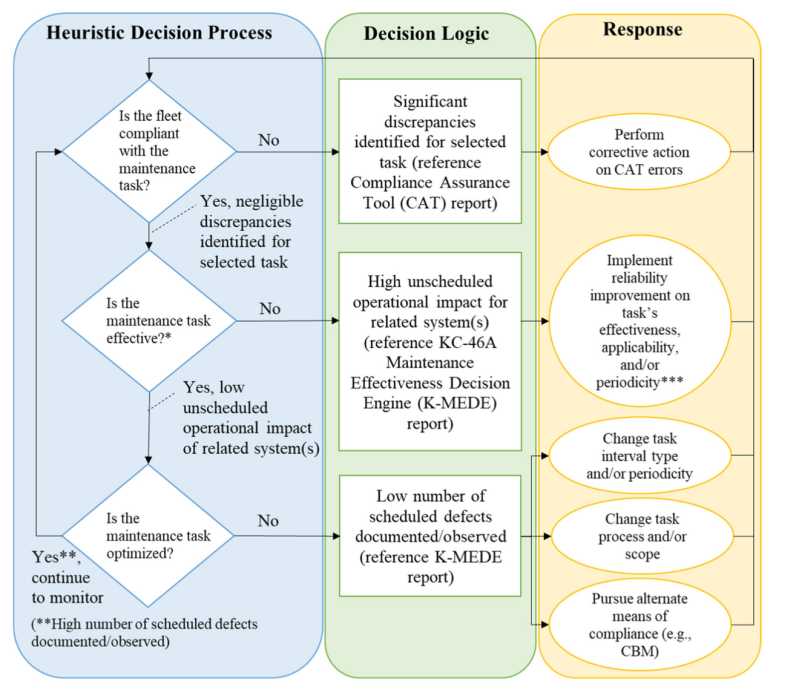
This figure represents the algorithmic “engine” of the Excel product, demonstrating that the tool is not a simple spreadsheet but a structured, architecture-driven decision-support system.
5. Validation & Product Testing
To evaluate the tool's efficacy, I applied it to the United States Air Force's KC-46A Tanker fleet and led a focus group of subject matter experts to validate the tool using:
-
multiple scenario inputs,
-
cross-analysis of enterprise architecture models,
-
sensitivity tests on classification thresholds,
-
and stakeholder walkthroughs to confirm interpretability.
The tool consistently and accurately classified enterprise R&M performance across a range of operational patterns.
Impact
Enterprise Level Impact
The Decision Analysis Tool delivers:
-
Transparent, architecture-based evaluation of enterprise R&M performance
-
Scalable and repeatable assessment logic
-
Alignment across organizational, operational, and data domains
-
Improved insight for senior leadership and sustainment decision makers
Product Development Impact
This tool represents a complete product development lifecycle, demonstrating my ability to:
-
Translate complex enterprise behaviors into functional product requirements
-
Lead architecture and algorithm design
-
Build an operational decision-support application
-
Validate product performance through structured testing
-
Deliver a usable tool for real-world decision environments
Role: Product Developer • Technical Lead • Decision-Support Architect
Core Deliverable: A semi-automated Decision Analysis Tool developed in Excel to evaluate and classify enterprise-level R&M performance
Publications:
- INCOSE 35th International Symposium: Enterprise Architecting to Advance Reliability and Maintainability Decision-Making
- Doctoral Dissertation: An Enterprise System Engineering Analysis of KC-46A Maintenance Program Decision-Making
- IEEE Annual R&M Symposium: A Decision-Making Framework for the KC-46A Maintenance Program
Create Your Own Website With Webador